World Cricket 3D: a T20 match in your browser
Bat one innings, bowl the other, and send the close ones upstairs.
World Cricket 3D is a cricket game in real-time 3D that runs in the browser. You pick a side, bat one innings and bowl the other against the computer, and the match is shown the way it is on television: the toss, the walk to the middle, replays of the big shots and a third umpire when a decision is close. Play it here, on a laptop or on a phone held sideways. It is free, with nothing to install and no sign-up.
Eleven sides, real names
India, Australia, England, South Africa, New Zealand, Pakistan, Sri Lanka, West Indies, Bangladesh, Afghanistan and Ireland, each with its T20 squad as it stood on 10 November 2026. The names are real and the faces are nobody's: every player is the same open-licence figure, varied by height, build, skin tone, hair and shirt number, and the kits carry no board or sponsor marks. The five grounds are made up too: Harbour Oval, the Old Mill Ground, Riverside Park, the National Bowl and Cliffside, each with its own stands, mowing pattern and pitch.
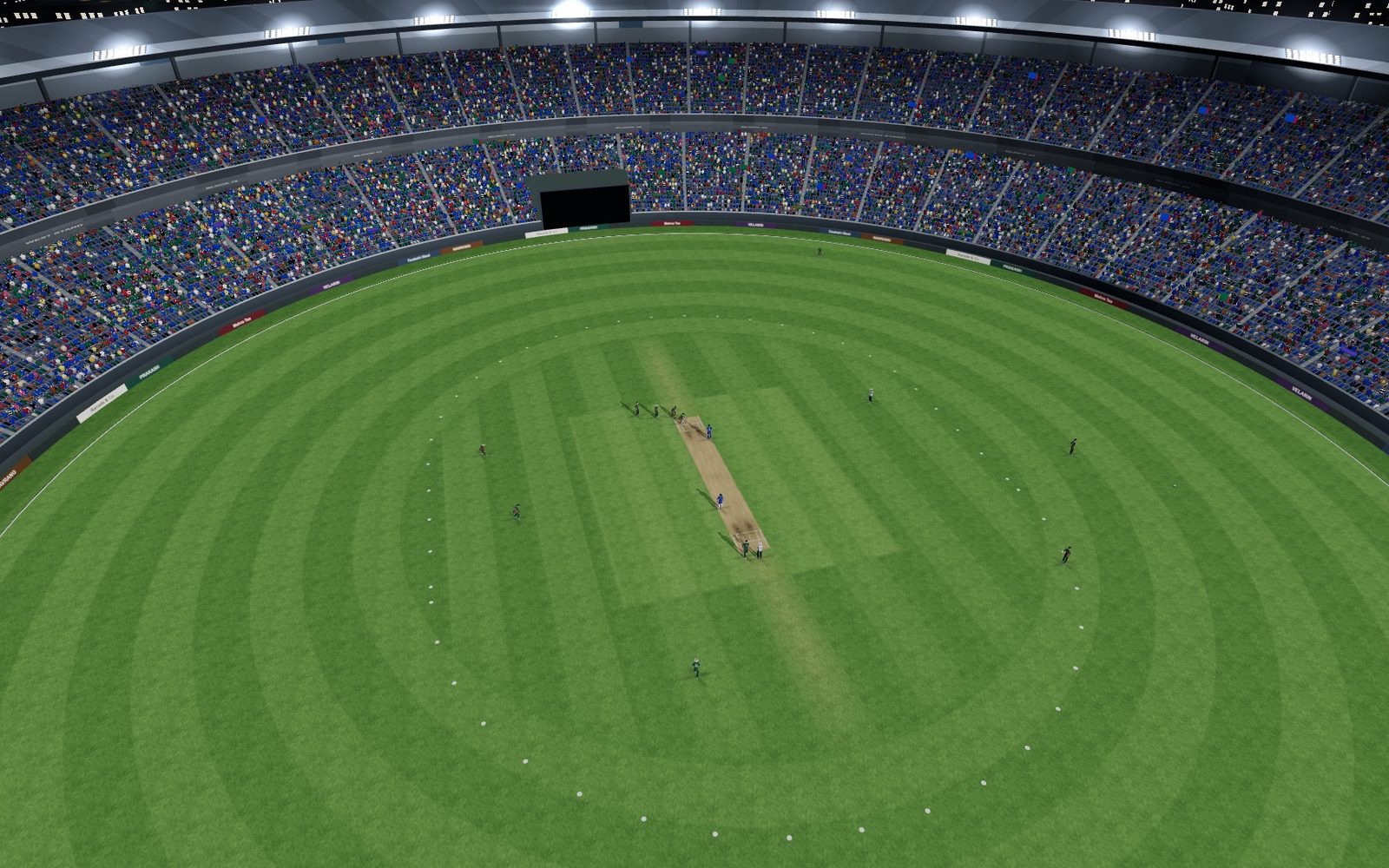
How a match opens
Ask for a toss and the two captains walk out to the referee in the middle, you call the coin, and the winner chooses. Then the fielders come out, then the openers, to a roar, and the box starts talking: "Hello and welcome to the Harbour Oval, here in Port Elder!" The two sides, the length of the match ("Just two overs a side, so every ball counts!"), the pitch, and at night, "A night game, the floodlights are on and the crowd's buzzing."
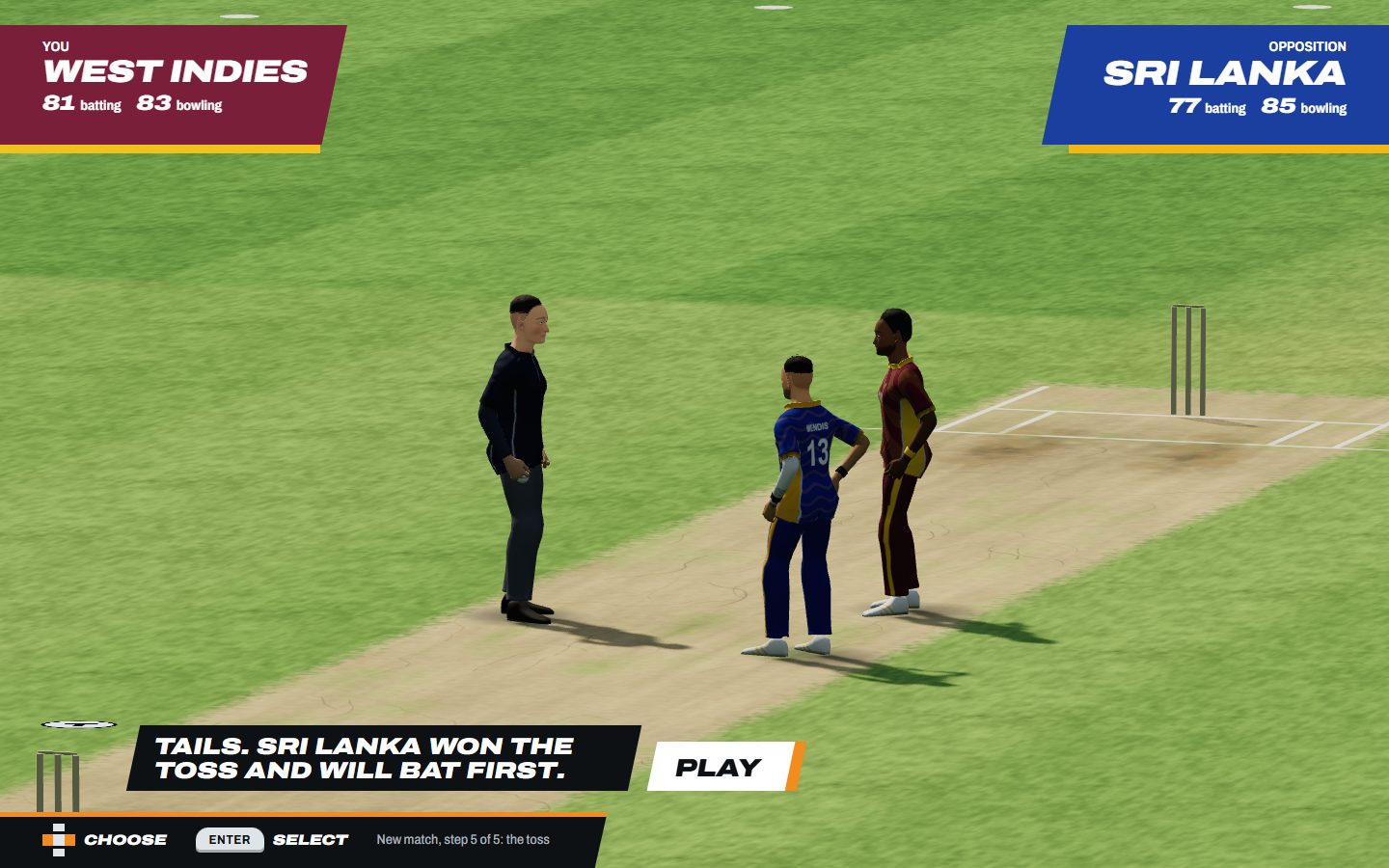
Going upstairs
When the umpire gives a decision you don't like, the game asks: Review, or Accept. Take it and the third umpire goes through it in steps, as on television. First the front foot: was it a fair delivery? Then the edge, a sound trace as the ball passes the bat. Then ball tracking, worked out from the same physics as the ball you just watched: where it pitched, where it hit the pad, and whether it was going on to the stumps. If less than half the ball would have hit them, it is umpire's call: the decision on the field stands and the side keeps its review.
A side gets one review an innings in a 2 or 5 over match and two in a 10 or 20. The computer reviews too, and the umpires send tight run outs and stumpings upstairs themselves.
After the last ball
Wickets get a huddle and a new batter walking in. Big shots get a slow-motion replay of the real ball, not a canned clip. When the match ends, the winners celebrate one of seven ways (a pile-on, a slow walk along the rope waving to the stands, the captain pulling out a stump), the losers take it one of seven ways, both sides shake hands in two lines, and the player of the match goes to the presenter. One press skips any of it. Options, Telecast sets how much you see: on Auto, a 2 or 5 over match gets the full telecast and a 10 or 20 over match a brisk one with short scenes.
Playing on a laptop
It is all keyboard. Batting, the arrows choose where to hit it, S plays a ground stroke, D lofts it, A defends, W sweeps and Q leaves. Hold Shift to walk down the pitch. Space runs, and X sends your partner back. Timing decides the contact, so edges, catches and how far a six goes all come out of where bat meets ball. Bowling, pick a delivery with 1 to 5, move the marker with the arrows to set the line and length, then press Space to start the run-up and again to stop the meter: green is good, the white band inside it is perfect, amber is late and past the red line is a no ball. R reviews, Esc pauses, M mutes and G goes full screen.
Playing on a phone
Turn it sideways. The pad on the left sets the direction of the shot, or moves the pitching marker when you bowl. The buttons on the right change with the moment: Stroke, Loft, Defend, Sweep and Leave when you bat, Run and Send back between the wickets, Run in and Release when you bowl, Review and Accept when the umpire has spoken. The tap that starts a match also goes full screen; an iPhone can't, so it suggests Add to Home Screen. Held upright, the game pauses and asks you to turn the phone.
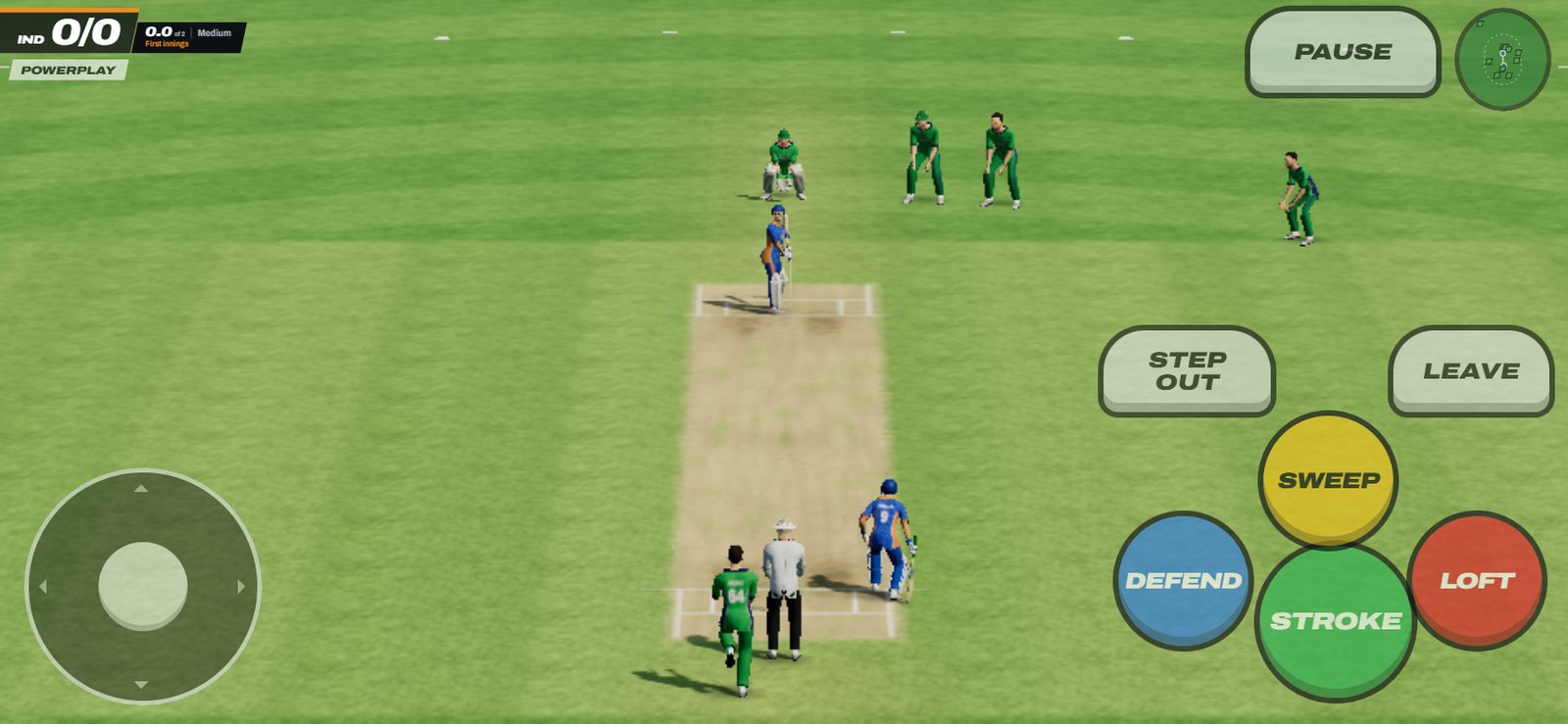
There are three graphics levels, and if the browser is drawing without the graphics card, the game says so and tells you how to fix it.
The choices
Quick match puts you in a game with one press. New match lets you pick both sides and your eleven, then the match: 2, 5, 10 or 20 overs a side, any of the five grounds or one picked for you, day in the afternoon sun or night under the floodlights, a green, flat, dry or dusty pitch, easy, medium or hard (the level you picked stays on the scoreboard strip and the pause screen), and the toss or straight to batting or bowling first. The powerplay and the bowlers' quotas scale with the length of the match, and a tie goes to a super over. The game saves after every ball, so you can close the tab and pick the match up again from the title screen.
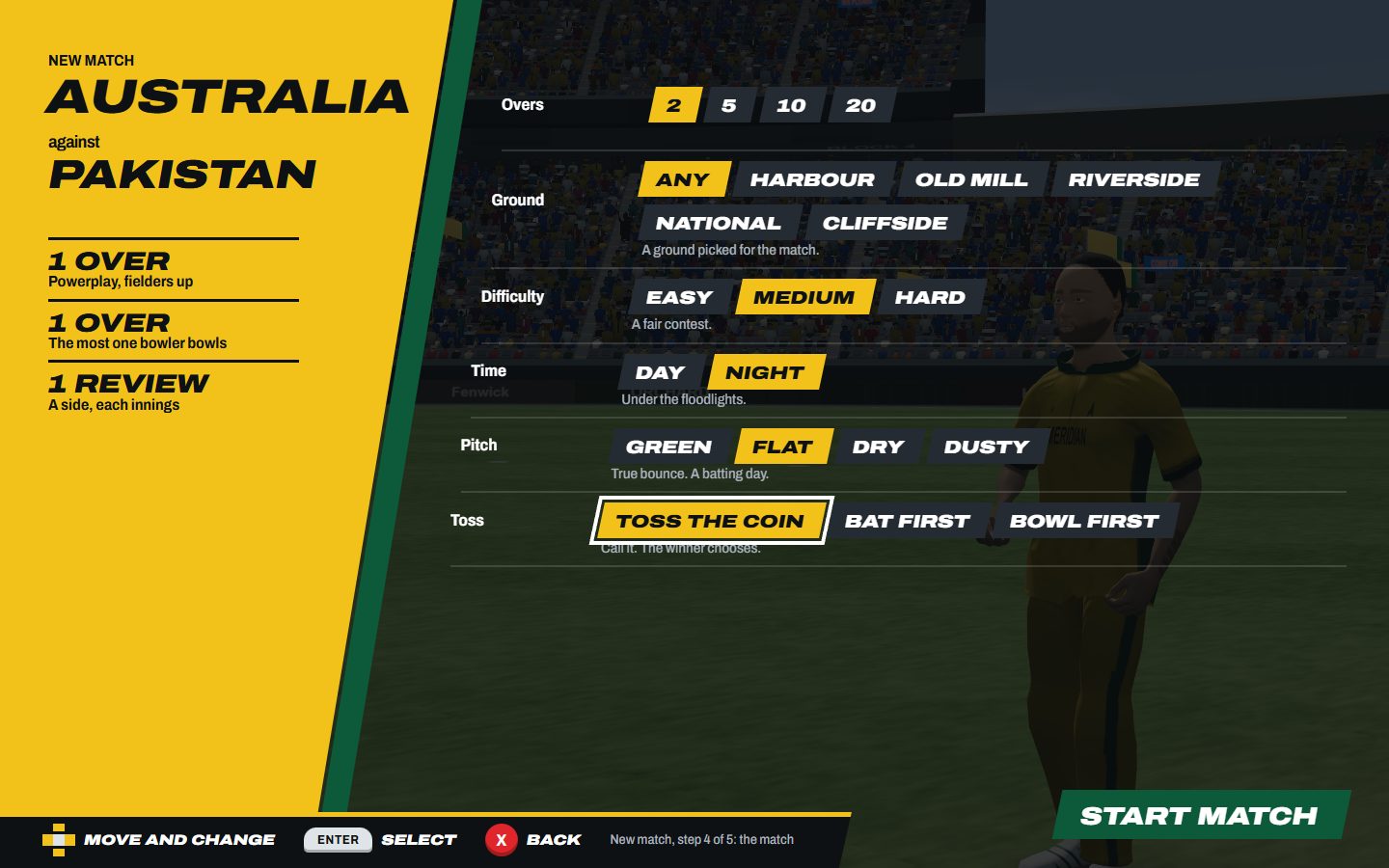
What's next
The game keeps getting updates. Coming up: a new third umpire review with fuller ball tracking, new batting animations taken from real shots, proper fields for spinners, and more commentary. The title screen has a What's new card that lists each update as it lands.
How it is made
Plain JavaScript and three.js (release 185), with no framework and no game engine. Some of what is underneath:
- Light to load. The page you land on is 790 KB, held under an 800 KB limit, so the title screen comes up quickly. three.js, the game itself and its models and sounds, about 29 MB, follow in the background.
- Cheap to draw. The ground, the pitch and its creases, the stands and the floodlights are all built in code. Each player is one model on a 37-bone skeleton, bat and pads included, drawn in a single call, with a lighter version for anyone far from the camera. The crowd is up to 16,000 flat figures on the real seat rows. A full field is about 56,000 triangles on medium quality, and if the frame rate drops the game steps down a quality level by itself.
- A match underneath the picture. The cricket runs as a simulation at a fixed 120 steps a second, apart from the drawing, and every random choice comes from a seeded generator, with its own stream for each part of the game. The same seed and the same presses give the same match. Replays are recordings of what was already played, so watching one never changes the result.
- Ball physics. The ball flies under gravity and air drag, swings off the seam (conventional with a new ball, reverse with an old one at high pace) and bounces with friction, which is why spin turns it. Each pitch sets its own bounce, grip, turn and seam movement. The fielders, the computer's batters and the ball tracking in a review all predict the ball with the same physics, and the review follows the playing conditions: umpire's call on impact, on the stumps, and for an impact more than 3 metres from them.
- The computer's side. The computer bowler plans each ball and its captain picks the bowlers within their quotas. The computer batter chooses a stroke from where the ball will be, whether it is going on to hit the stumps, the field and how hard the match says to push. In the field, whoever can reach the ball's path first goes for it, the next man backs up and someone covers the stumps. Difficulty sets how cleverly the computer bowls, and on Easy its batters take riskier runs.
- Animation made by hand. No motion capture. Every stroke is a set of key poses on the game's own skeleton, timed from real cricket footage. A solver places both hands on the handle in every frame, inside the joints' limits, and the stroke is timed so the bat meets the ball on the exact frame the simulation says it does.
- Sound. The crowd is built from recordings under open licences, never looped the same way twice: short stretches overlap and fade into each other, a busier layer comes up as the bowler runs in, and it all goes quiet while the third umpire looks. The music is by Kevin MacLeod (incompetech.com) with a dhol beat by Johnny Kalsi of The Dhol Foundation, all under Creative Commons; the full list is on the Credits screen.
- Testing. The game has about ninety files of automated tests; one of them plays 300 simulated matches and checks that every score adds up. Full matches are also played automatically in a real browser on a phone-sized screen.